Labor's End by Jason Resnikoff
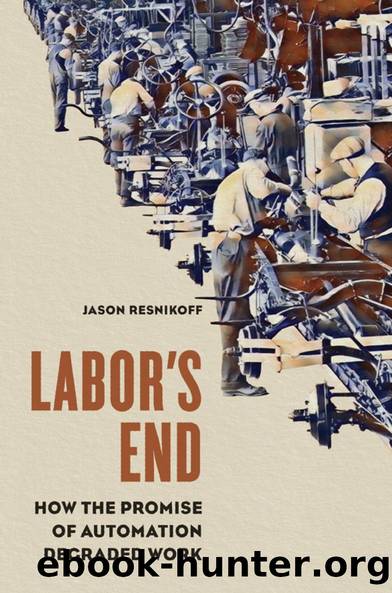
Author:Jason Resnikoff [Resnikoff, Jason]
Language: eng
Format: epub
Tags: History, General, United States, 20th Century, Business & Economics, Labor, Political Science, Labor & Industrial Relations
ISBN: 9780252086298
Google: LcxXzgEACAAJ
Publisher: University of Illinois Press
Published: 2022-01-18T02:49:37+00:00
Surely, this was a definition of work far different from that promoted through the automation discourse. It showed the influence of C. Wright Mills, who in White Collar had argued that âwork has no intrinsic meaning,â good or bad, and that the meaning of work was essentially ideological, and therefore political.46 More directly, the Port Huron Statementâs understanding of work drew on the thought of another prophet of the New Left, Paul Goodman, author of the 1960 surprise bestseller and manifesto of the youth rebellion, Growing Up Absurd. Poet, philosopher, playwright, novelist, teacher, pacifist, and hardly a youth in 1960, the forty-nine-year-old Goodman did not share the eraâs technological optimism, nor did he blame scarcity for the travails of history. He wanted âa more sensible abundance,â one that satisfied not only empty stomachs but spiritual hunger. Modern society, he argued, was âlacking enough manâs work.â In short, he wrote, âThere are not enough worthy jobs.â47 Rather than abolish work, Goodman hoped to âmake industrial technology humanly important for its workmen.â As Arendt had two years earlier, Goodman demanded the reconciliation of freedom and necessity. âNecessity,â he wrote, âgives justification.â48 A healthy community offered its young people authentic necessities, real jobs, and genuine dutiesânot just a mission, but a noble mission. In Goodmanâs masculinist language: âIf there is little interest, honor, or manliness in the working part of our way of life, can we hope for much in the leisure part?â If people decided to, he believed, they could make factory jobs good jobs. If people had a meaningful say over their work, a job would become âman-worthy,â whether the necessity was the composition of a poem or the repair of an automobile.49
As much as Goodmanâs line of thought might have informed the authors of the Port Huron Statement, for most of the 1960s only a sliver of the young New Left still saw the industrial shop floor as the decisive battleground of the revolution. Millsâs criticism of the âlabour metaphysicâ held sway. By 1963, Goodmanâs analysis of work had ceased to persuade the SDS leadership. The automation discourse seemed a better description of reality, especially when authorities on the Left from Galbraith to Marcuse insisted that humanity now possessed the technological capability to eliminate all industrial labor and replace it with either leisure or professional white-collar employment. If in 1962 the Port Huron Statement had hoped to restore âa sense of dignityâ to work, a year later both Gitlin and Hayden represented the new take on the subject.50 The âera of scarcityâ was at an end, Gitlin wrote in October 1963. âNow,â he continued, âthe replacement of human machines by automated machinery makes possible the freeing of men for employment as full persons in the making of society.â With the new machines, he argued in the same vein as Ferry and Theobald, âwe can be entire unto ourselves. The economic necessity of a crippling constriction is lifted; men become free to assume the general and integrative role of citizen. We
Download
This site does not store any files on its server. We only index and link to content provided by other sites. Please contact the content providers to delete copyright contents if any and email us, we'll remove relevant links or contents immediately.
| Anthropology | Archaeology |
| Philosophy | Politics & Government |
| Social Sciences | Sociology |
| Women's Studies |
The Secret History by Donna Tartt(19088)
The Social Justice Warrior Handbook by Lisa De Pasquale(12190)
Thirteen Reasons Why by Jay Asher(8910)
This Is How You Lose Her by Junot Diaz(6887)
Weapons of Math Destruction by Cathy O'Neil(6280)
Zero to One by Peter Thiel(5802)
Beartown by Fredrik Backman(5754)
The Myth of the Strong Leader by Archie Brown(5507)
The Fire Next Time by James Baldwin(5446)
How Democracies Die by Steven Levitsky & Daniel Ziblatt(5219)
Promise Me, Dad by Joe Biden(5153)
Stone's Rules by Roger Stone(5088)
A Higher Loyalty: Truth, Lies, and Leadership by James Comey(4964)
100 Deadly Skills by Clint Emerson(4925)
Rise and Kill First by Ronen Bergman(4789)
Secrecy World by Jake Bernstein(4753)
The David Icke Guide to the Global Conspiracy (and how to end it) by David Icke(4720)
The Farm by Tom Rob Smith(4512)
The Doomsday Machine by Daniel Ellsberg(4490)
